Category: IoT

  • Types of Internet of Things (IoT)

    Types of Internet of Things (IoT)

    The main objective of Internet of Things (IoT) is

    • To globally connect smart ‘things’ or ‘objects’.
    • Objects are uniquely identified.
    • Interoperability among the objects.

    These concepts are well explained in ‘Introduction to Internet of Things.

    Internet of things (IoT) is categorized in 3 segments:

    1. Industrial IoT  (IIOT)
    2. Consumer IoT (CIOT)
    3. Enterprise IoT (EIOT).

    In 5G Americas white paper 5G-The future of IOT it is mentioning that types of IoT use cases is not so much based upon the ‘who’ or ‘where’ but the requirements for the technology implemented.

    This means the segmentation is not based upon what are the equipment, devices used in the system.

    Same sensors, same actuators, and all other devices may be same in all 3 cases.

    The devices used in home, in office, in a factory have the same functionalities.

    But segmentation is done based on requirement of features of IoT connectivity in each sectors.

    Mainly these 3 categories are done based on the below requirements:

    • Security
    • Interoperability
    • Scalability
    • Precision and Accuracy
    • Programmability
    • Low Latency
    • Reliability
    • Resiliency
    • Automation
    • Serviceability
    • Data volume
    • Data throughput

    Some of these characteristics we have discussed in Introduction to Internet of Things (IoT).

    Security is a major concern in all three categories.

    In some scenario we may require very low latency and low data throughput. In some other cases we may compromise latency up to some level, but data uses or requirement of data throughput is very high.

    Get YOUR Copy HERE.

    1.Industrial Internet of Things (IIoT):

    The industrial Internet of Things (IIot) is an application of IoT in industries to modify the various existing industrial systems.IIoT links the automation system with enterprise, planning and product life cycle.

    IIoT includes major industries like:

    • Oil and Gas,
    • Transportation,
    • Manufacturing,
    • Healthcare and Energy.

    Accenture forecast that the Industrial IoT will reach $123 billion in 2021, attaining a CAGR of 7.3 percent through 2020(Ibid). Accenture also forecast that IIoT can add as much as $14.2 trillion to the global economy by 2030 (Ibid)

    Component of IIoT:

    Some integral component of Industrial IoT (IIoT) are

    • Machine Learning
    • Big data technology
    • Machine to Machine interaction (M2M)
    • Automation

    Machine Learning-

    Learning from the existing data and trying to make things predictive and trying to have things which are better in the future, based on current available data.

    Big data technology- 

    Big data means very big is size which ca not be processed with usual tools.

    Big data is mainly based on 3 Vs. Those are

    V- Volume of data: e.g. 500 TB per day (like in Facebook).

    V- Velocity of data: e.g. trying to handle many requests per seconds (like in Google)

    V-Variety of data: e.g. Problem at hand and data we will process are complex.

    Machine to Machine interaction (M2M)& Automation-

    Two or more machines directly interact with one another to complete some purpose or task without any human interventions.

    Thus make the things possible to work in automation.

    Industrial IoT (IIoT) and Industry 4.0:

    The scope of Industry IoT (IIoT) borrows some features of IoT and borrows some features from vision of Industry 4.0.

    Industry 4.0 is basically a framework for:

    • Automation and data exchange in manufacturing technologies.
    • Cyber-physical systems, Internet of things and cloud computing.
    • Smart factory.

    2.Enterprise IoT (EIoT):

    The ultimate need for enterprise to drive IoT is to enhance:

    • Operational efficiency,
    • Mitigate risk,
    • Improve functional visibility,
    • Ensure maximum customer engagement,
    • Increases revenue streams,
    • And tap into potential opportunities for growth.

    For connectivity purpose-

    The 5G network is capable of supporting massive devices and new services, for example

    • Enhanced Mobile Broadband (eMBB),
    • Massive Machine type communication (mMTC),
    • Critical communications and network operations

    compared to 4G-LTE network.

    5G mobile system for Enterprise IoT is trusted to provide low latency, high versatility and high throughput for large number of gadgets

    Use cases:

    Enterprise IoT would have the greatest impact in

    • Service Operations
    • Manufacturing.

    These two broad groups can be further distributed into:

    • Supply Chain
    • Research & Development (R&D)
    • Marketing and Sales
    • And small segment of other parts of enterprise.

    For example, manufacturing machines at the manufacturing floors are integrated with

    • Enterprise resource planning (ERP),
    • Customer relationship management (CRM),
    • Supply chain management (SCM),
    • And knowledge management (KM) applications in order to ensure utmost automation.

    The results and outputs are simply the aggregated ones. Any event information gets instantaneously captured and processed in order to activate appropriate systems in time.

    Any slight delay may lead to destruction. The much needed integration gets fulfilled through a host of integrators, connectors, drivers, and adaptors.

    Key Drivers for Enterprise IoT:

    The Enterprise IoT (EIoT) is relatively new development in the IoT sector.

    Key drivers of Enterprise IoT (EIoT) are, but not limited to:

    • Infrastructure optimization
    • Process excellence
    • Architecture assimilation
    • Technology adaption and adoption
    • Leverage data (internal as well as external) toward actionable insights

    3.Consumer IoT (CIoT):

    The IoT is changing how consumers interact with consumer electronics, enabling greater convenience for a better experience, access to data that enables them to optimize their usage, and increasing control they have over their devices.

    With IoT, the world is at our fingertips.

    Wearables,gadgets and gizmos, portables, implantable, handhelds, consoles, appliances, instruments, and utensils are the fast-emerging and evolving IoT products.

    The number of connected devices in the hands of people in our everyday works and walks are drastically increasing.

    Use cases:

    • Fitness tracker,
    • Smart home thermostat,
    • Wi-Fi connected camera,
    • Virtual reality headset,
    • smart refrigerator and toaster,
    • Alarm panel
    • Smart glasses.

    The connection between all of them is that they are often controlled by apps.

    Growth of Consumer IoT (CIoT):

    Consumer IoT is no more in the study state. These are already in our used cases and it is very fast growing sector of IoT.

    For example, as per Statista The North America IoT consumer electronics market is predicted to increase from $90B in 2017 to $180B in 2022, attaining a CAGR of 12.25 percent.

    Summary:

    In this article we just touched all the categories of Internet of Things (IoT) to give a brief idea.

    We will go deep in to all segments in upcoming blogs.

    Thanks for reading this blog.

    Your feedback, comments, suggestions or like are highly appreciated.

    Ref:

    5G Americas: 5G-The Future of IoT

    The Internet of Things- by Pethuru Raj &Anupama C. Raman

    Introduction to IoT- by Dr. Sudip Misra

    Get YOUR Copy HERE.

    Pranab Hazarika

    BE | MBA | PMP | IoT-Certified

    www.PranabHazarika.com
  • Introduction to Internet of Things (IoT)

    Introduction to Internet of Things (IoT)

    A formal definition of Internet of Things is as below:

    “”The Internet of Things (IoT) is the network of physical objects that contain embedded technology to communicate and sense or interact with their internal states or the external environment.””

    Now let’s understand Internet of Things in very simple way.

    Till now when we say internet based services we understand connections of different computers and computing devices.

    Now the Internet of Things says that the scope of internet is expanded or going to be expanded beyond computers and computing devices.

    Now whatever “things” we can see, we can touch can be a part of the internet of world.

    They will communicate in between, with humans and so on.

    So in simple terms anything can be connected to the internet world and this is called Internet of Things (IoT).

    IoT is no more in research state and by 2020 it is expected that 50 billion devices will be part of IoT.

    This count will increase gradually as the use of devices, equipment, home appliances are increasing day by day and they are always more than human beings.

    Get your copy here

    Application of Internet of Things (IoT):

    Some applications of Internet of Things in different domains are as below but not limited to:

    • Home: Smart Lighting, Smart Appliances
    • Cities: Smart Parking, Smart Roads
    • Environment: Weather Monitoring, Noise Pollution Monitoring
    • Energy: Smart Grids, Renewable Energy System
    • Retail: Inventory Management, Smart Payments
    • Logistics: Shipment Monitoring, Route Generation
    • Agriculture: Smart Irrigation, Green House Control
    • Industry: Indoor Air Quality Monitoring, Machine Diagnosis
    • Health & Lifestyle: Fitness Monitoring, Wearable Electronics

    Market Drivers of Internet of Things (IoT):

    IoT is a new game changer for businesses and individuals and is considered to be the fourth industrial revolution by experts and scientists.

    The drivers and trends that contribute to the massive growth and development of IoT are as below, but not limited to:

    • 3GPP standards
    • Expanded and low cost internet connectivity
    • Expanded mobile communication
    • Emerging of new mobile technology like LTE and 5G.
    • Low cost sensors
    • Large IoT investments
    • Growing importance of Automation
    • Big data knowledge
    • Artificial Intelligence
    • Machine learning
    • Deep learning
    • Edge computing and cloud
    • Security assistance
    • IPV6 addressing system

    Characteristics:

    Different characteristics of IoT are:

    • Efficient, scalable and associated architecture
    • Unambiguous naming and addressing
    • Abundance of sleeping nodes, mobile nodes.
    • Intermittent connectivity
    • As we already came to know that in IoT billions of, trillions of devices are going to be interconnected so, it must be scalable and as well as efficient too.
    • Identification of each nodes must be unique. Currently IPV4 system is usually used for IP addressing which is having 32 bit addressing scheme.

    For IoT we need to think beyond IPV4 and necessity to go for IPV6. IPV6 is having 128 bit addressing scheme.

    • There should be large number of sleeping nodes in the system.

    Whenever they are not being used they should be in sleeping mode and as per requirement make them active.

    As there are large no of nodes connected in the network it is not possible to check and change battery or power supply to the nodes very frequently.

    So the battery life of the nodes should be very large like many years. To make the battery life long, we should make some arrangement so that all nodes are continuously not active and go to sleep mode when they are not required to be active.

    By this way we can make long battery life of the nodes and thus make them long live.

    • Mobility of the nodes is also a part of IoT network.

    e.g. if a person is wearing a smart watch, along with the person that nodes must also be mobile and should work properly during mobility.

    • Intermittent Connectivity means one device currently connected to a particular device may not be connected to it at a later instance of time and gets connected to some other new device or devices.

    IoT Market Share:

    IoT is attractive in different application domains.

    A study found that currently the IoT market share in different domains are like (Source: Intel)

    Manufacturing/ Business: 40.2%

    Healthcare: 30.3%

    Retail: 8.3%

    Security: 7.7%.

    So we have seen that currently Manufacturing /Business is on the top of the IoT market share.

    It improves overall supply chain management, different sensors, actuators, different robotic machinery can be used to improve the business process.

    In healthcare remote areas can be connected to the different health care facilities of doctors, nurses, and other services whether they are present in front of them or not.

    They will be remotely connected and treated.

    Recordkeeping and access remotely to those reports is also an added advantages to healthcare industry.

    In case of Retail sectors tasks such as inventory tracking, smartphone purchasing, anonymous analytics of consumer choices, these are the different things that can be done efficiently through use of IoT.

    Fingerprint, biometric and facial recognition these technologies can be connected and used with the help of IoT for Security purpose.

    Machine to Machine (M2M) Communications:

    Machine to Machine (M2M) communications was first introduced by Telecommunications service providers (TSP).

    Earlier IoT was referred to as Machine to Machine (M2M) communications only.

    M2M means devices connected to internet can communicate to one another through wired and mostly wireless network.

    From this concept of M2M with evolved communication technology like 4G-LTE or 5G, concept of MASSIVE IoT deployment comes in to picture.

    Along with Massive another part of IoT is CRITICAL IoT.

    Massive IoT:

    Requirements of Massive IoT:

    • Low cost
    • Low energy
    • Small data volumes
    • and Massive numbers of devices.

    Examples are like smart buildings, smart agriculture, logistic tracking and management etc.

    Critical IoT:

    Requirements of CriticalIoT:

    • Ultra-Reliable
    • Very low latency
    • Very high reliability

    Examples are like remote health care, traffic safety and control, industrial applications and control etc.

    M2M expansion is growing in very high speed and Cisco predicting that by 2022 there will be 14.6 billion machine-to machine (M2M) IoT connections.

    IoT Vs M2M:

    M2M refers to the communications between machines and devices.

    Internet of Things (IoT) is a wider concept and M2M is a part of IoT, reverse is not.

    Expectation of IoT:

    Applications of IoT can be expected in almost every sphere of society and any sphere of life.

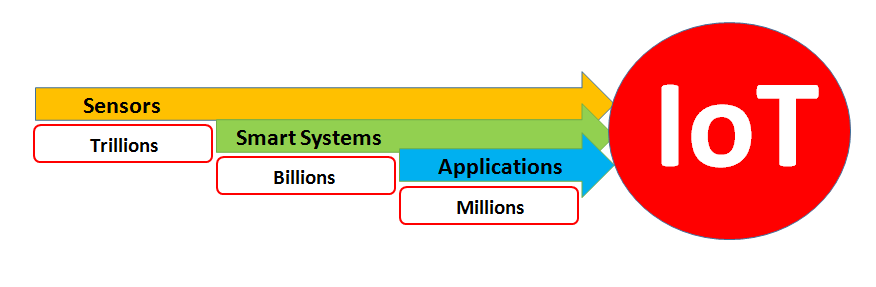
    It is expected to have trillions of sensors (nodes), billions of smart systems and millions of applications are going to be internetworked.

    Summary:

    This is just a beginning of the Internet of Things (IoT) chapter.

    In upcoming blogs we will go deep in to the concepts, theory, devices and applications of IoT in details.

    Thanks for reading this blog.

    Your feedback, comments, suggestions or like are highly appreciated.

    Ref: Internet of Things, A Hands-on approach by Arshdeep Bahga& Vijay Madiset

    5G the future of IoT, 5G Americas

    Internet of Things: Dr. Sudip Misra

    Get your copy here
    Get your copy here

    Pranab Hazarika

    BE | MBA | PMP | IoT-Certified