Author: Pranab Hazarika

  • Do we need 5G for Netflix, Instagram, or Facebook?

    Do we need 5G for Netflix, Instagram, or Facebook?

    Do we genuinely require 5G technology for our daily data needs? The International Telecommunication Union (ITU) has mandated a remarkably low latency of 1ms for 5G-NR. Latency, in simpler terms, is the time it takes to transfer data from the mobile tower (gNB) to the user equipment, such as your mobile or other devices.

    5G’s Lightning-Fast Data Transfer

    To grasp the significance of 1ms, consider the blink of an eye. Researchers at UCL suggest an average blink duration of 100–150 milliseconds, while the Harvard Database of Useful Biological Numbers notes a range of 100 to 400 milliseconds (source: https://en.wikipedia.org/wiki/Blinking).

    With this in mind, imagine the lightning-fast data transfer capabilities of 5G, particularly under ideal conditions. All factors align perfectly in this scenario, from abundant bandwidth and optimal network conditions to the strongest signal strength.

    4G Versus 5G: Streaming and Beyond

    Now, let’s return to the essential question: Do we need 5G to enjoy streaming on Netflix, browsing Instagram, or scrolling through Facebook? The current 4G network is often more than sufficient for everyday users like you and me. If you’ve ever experienced issues like occasional buffering while watching Netflix, the culprit is typically not the absence of 4G-LTE technology. Instead, it’s often a result of the network’s quality, which the operator provides. Factors like signal strength and available bandwidth come into play here. For an operator, bandwidth is akin to the size of a water pipe—the larger the pipe, the more data flows to your device in less time. In this analogy, smaller pipes take longer to deliver the same volume of data.

    So, if we’ve clarified this far, the question arises: Why is 5G-NR technology generating so much buzz, with operators racing to adopt it?

    The promise of enhanced speed and more significant data volume offers users a future of digital luxury. However, this utopia will only be realized after several years when 5G handsets are ubiquitous and a nearly seamless 5G network covers the globe.

    But before we get to that stage, let’s explore why ITU is pushing for 5G-NR technology, considering various use-case scenarios and their specific criteria.

    5G-NR Use cases

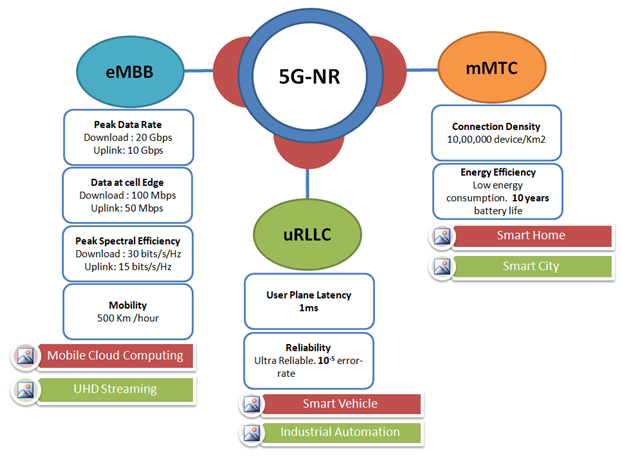
    ITU suggests 3 prominent use cases for the development of 5G-NR.

    3 primary use cases for 5G:

     1. eMBB (enhanced Mobile Broadband) for tasks like mobile cloud computing.

     2. uRLLC (ultra-Reliable Low Latency Communications), ideal for applications such as Smart Vehicles.

     3. mMTC (Massive Machine Type Communications), e.g. for Smart Cities.

    Each use case has specific requirements.

    It’s important to note that a single type of technology isn’t confined to just one specific use case. A smart vehicle, as an example, can seamlessly fit into all three categories. It falls under uRLLC due to its demand for high reliability and ultra-low latency. Moreover, it might incorporate devices within the uMBB category, utilize high-data-rate services, and even accommodate numerous smaller devices needing extended battery life.

    Conclusion:

    These advanced use cases raise the question of why we’re considering 5G for our day-to-day mobile usage.

    It’s akin to choosing between a 5-star or 4-star hotel at nearly the same price.

    After all, who doesn’t appreciate a touch of luxury?

  • The Intricate Dance of Time, Light, and Mass: Unraveling Einstein’s E=mc2

    The Intricate Dance of Time, Light, and Mass: Unraveling Einstein’s E=mc2

    In the vast realm of physics, few equations are as iconic as Einstein’s E=mc^2. At its core, this equation binds the concepts of energy, mass, and the speed of light in a profound relationship that has reshaped our understanding of the universe. Let’s embark on a journey to understand the intricate dance between time, the speed of light, and mass, all through the lens of this legendary equation.

    1. The Essence of E=mc^2:

       -E: Represents energy, a measure of the ability to do work or cause change.

       – m: Stands for mass, the amount of matter in an object.

       – c: Denotes the speed of light in a vacuum, approximately 3*10^8 meters per second. When squared, this value becomes an incredibly large number, emphasizing the immense energy contained within even a small amount of mass.

    2. The Speed of Light as a Cosmic Speed Limit:

       The speed of light isn’t just another number; it’s a fundamental constant of nature. According to Einstein’s theory of relativity, nothing can travel faster than light. This isn’t merely about photons zipping through space; it’s a statement about the very fabric of spacetime. As objects with mass accelerate closer to the speed of light, they require more energy, and their effective mass increases, making it impossible to ever reach or surpass this cosmic speed limit.

    3. Time Dilation: When Time Slows Down:

       One of the most mind-bending consequences of relativity is time dilation. As an object’s speed approaches the speed of light, time for that object appears to slow down relative to a stationary observer. This isn’t a mere illusion; it’s a fundamental aspect of how time and speed intertwine in our universe. Imagine a clock on a spaceship traveling near the speed of light. To an observer on Earth, the clock would appear to tick more slowly than one on our planet.

    4. Mass and Energy: Two Sides of the Same Coin:

    E=mc^2 tells us that mass and energy are interchangeable. This concept is vividly demonstrated in nuclear reactions, where tiny amounts of mass are converted into vast amounts of energy. The sun, for instance, powers itself by converting hydrogen into helium, releasing energy in the process. This energy, derived from a minuscule loss of mass, is what lights up our skies and warms our planet.

    5. Implications for the Modern World:

    The relationship between mass, energy, and the speed of light isn’t just theoretical. It has practical implications. Nuclear power plants, for example, harness the energy released from the conversion of mass based on E=mc^2. Similarly, our understanding of the equation has paved the way for advancements in particle physics, leading to innovations like the Large Hadron Collider.

    Conclusion:

    Einstein’s E=mc^2 is more than just an equation; it’s a story. A story of a universe where time, light, and mass are intricately connected in a cosmic dance. As we continue to explore the depths of our universe, this relationship will undoubtedly guide us, challenging our perceptions and expanding our understanding of the cosmos.

    For those keen on delving deeper into this topic, I’d recommend reading Relativity: The Special and the General Theory” by Albert Einstein himself. It provides a comprehensive yet accessible exploration of these concepts.

    References:

    Einstein, A. Relativity: The Special and the General Theory.

    https://amzn.to/3DJPaaP

    – Feynman, R. P. (2011). Six not-so-easy pieces: Einstein’s relativity, symmetry, and space-time.

    https://amzn.to/3Kvr7Qw

    Pranab Hazarika

  • Accelerating Success: The Rapid Growth of SCRUM in Project Management Strategies

    Accelerating Success: The Rapid Growth of SCRUM in Project Management Strategies

    Introduction:

    In today’s fast-paced business environment, organizations are constantly striving to improve their project management methodologies to ensure efficient and successful project delivery. Among various approaches, Scrum has emerged as a popular and widely adopted framework that embraces the principles of agility. With its iterative and incremental nature, Scrum empowers teams to adapt, collaborate, and deliver value consistently. In this article, we will explore Scrum project management in depth, examining its core principles, roles, ceremonies, and benefits.

    1. The Essence of Scrum:

    Scrum is an agile framework that promotes flexibility, collaboration, and continuous improvement. Its core values are transparency, inspection, and adaptation. The framework is based on empirical process control, enabling teams to respond quickly to changing requirements and market conditions. Scrum divides the project into short iterations called sprints, allowing incremental development and frequent inspection of the product.

    2. Key Roles in Scrum:

    Scrum defines three primary roles that are essential for project success:

    a. Scrum Master: The Scrum Master is the servant-leader of the team. Their primary responsibility is to ensure that the Scrum framework is understood and followed. They remove any impediments, facilitate collaboration, and protect the team from external interruptions.

    b. Product Owner: The Product Owner represents the stakeholders and is responsible for maximizing the value delivered by the team. They prioritize the product backlog, define user stories, and ensure a clear understanding of the project vision.

    c. Development Team: The Development Team is a self-organizing and cross-functional group responsible for delivering a potentially shippable product increment at the end of each sprint. They collaborate, estimate tasks, and continuously improve their work processes.

    3. Scrum Ceremonies:

    Scrum introduces a set of ceremonies to facilitate communication, collaboration, and progress tracking within the team:

    a. Sprint Planning: At the beginning of each sprint, the team conducts a planning session to determine the sprint goal and define the tasks required to achieve it. The Product Owner presents the prioritized product backlog, and the team selects the items they commit to completing during the sprint.

    b. Daily Scrum: The Daily Scrum is a short daily meeting where the team synchronizes their work. Each team member answers three questions: What did I accomplish since the last Daily Scrum? What am I planning to do next? Are there any impediments blocking my progress?

    c. Sprint Review: At the end of each sprint, the team presents the completed work to the stakeholders, collects feedback, and discusses any changes or new requirements. The Product Owner reviews the progress against the sprint goal and adjusts the product backlog as necessary.

    d. Sprint Retrospective: The Sprint Retrospective is a reflection meeting where the team discusses what went well, what could be improved, and defines action items for the next sprint. It promotes continuous learning and process optimization.

    4. Artifacts in Scrum:

    Scrum introduces several artifacts to support project transparency and facilitate effective collaboration:

    a. Product Backlog: The Product Backlog is a prioritized list of user stories, features, and enhancements that constitute the project requirements. The Product Owner manages and continuously refines the backlog, ensuring it reflects the evolving needs of the stakeholders.

    b. Sprint Backlog: The Sprint Backlog is a subset of the Product Backlog items selected for the current sprint. It defines the tasks required to deliver the sprint goal and is owned by the Development Team.

    c. Increment: The Increment represents the sum of all completed and potentially shippable Product Backlog items at the end of each sprint. It must meet the Definition of Done (DoD) and should provide tangible value to the stakeholders.

    5. Benefits of Scrum:

    Implementing Scrum project management offers numerous advantages to organizations, teams, and stakeholders:

    a. Flexibility and Adaptability: Scrum embraces change and provides a flexible approach to project management. The iterative nature of sprints allows teams to adjust priorities, incorporate feedback, and adapt to evolving requirements. This enables faster response times and ensures that the product remains aligned with customer needs and market demands.

    b. Increased Collaboration: Scrum promotes a collaborative environment where all team members work together towards a common goal. The self-organizing nature of the Development Team fosters a sense of ownership and accountability, encouraging creativity and innovation. Daily Scrum meetings facilitate communication and transparency, enabling better coordination and problem-solving.

    c. Continuous Value Delivery: With Scrum, value is delivered incrementally at the end of each sprint. This allows stakeholders to see tangible progress and provide feedback early in the project. By focusing on delivering a potentially shippable product increment, Scrum ensures that the most valuable features are prioritized and delivered first, maximizing ROI and customer satisfaction.

    d. Transparency and Visibility: Scrum emphasizes transparency throughout the project lifecycle. The Product Backlog, Sprint Backlog, and Sprint Burndown Chart provide clear visibility into project progress, tasks, and timelines. This transparency enables stakeholders to have a real-time understanding of the project’s status, fosters trust, and facilitates effective decision-making.

    e. Continuous Improvement: The Sprint Retrospective is a key Scrum ceremony dedicated to reflecting on the team’s performance and identifying areas for improvement. By regularly inspecting their processes and adapting accordingly, teams can continuously enhance their productivity, efficiency, and product quality. This focus on continuous improvement helps create a culture of learning and innovation within the organization.

    f. Early Risk Identification: Scrum’s iterative approach allows for early identification of risks and issues. With short sprints, teams can quickly identify and address challenges, minimizing the impact on the overall project. Regular feedback loops and frequent inspections enable proactive risk management, ensuring that potential problems are mitigated in a timely manner.

    g. Predictable and Reliable Delivery: Scrum’s emphasis on regular sprints and incremental development leads to a more predictable and reliable delivery process. Through the use of time-boxed sprints and the commitment-based approach, teams can accurately forecast their capacity and commit to achievable goals. This predictability enables better planning, resource allocation, and stakeholder management.

    Conclusion:

    Scrum project management has gained widespread popularity for its ability to foster flexibility, collaboration, and value delivery. By embracing Scrum’s core principles, implementing its defined roles, ceremonies, and artifacts, organizations can achieve enhanced productivity, improved customer satisfaction, and a competitive edge in the market. The iterative and adaptive nature of Scrum empowers teams to respond swiftly to changing requirements, leading to successful project outcomes. As businesses continue to navigate the complexities of the modern landscape, Scrum remains a powerful and effective framework for managing projects and driving innovation.

    To read about Agile Methodologies and Project Management check the links below:

    Pranab Hazarika

    BE |MBA|PMP| IoT

    Get your copy here
    Get your copy here
  • Agile Methodology: Driving Efficiency and Adaptability in Project Management

    Agile Methodology: Driving Efficiency and Adaptability in Project Management

    In today’s rapidly evolving business landscape, organizations face increasing pressure to deliver projects efficiently, adapt to changing requirements, and maximize customer satisfaction. Traditional project management approaches often struggle to meet these demands, leading to delays, scope creep, and reduced overall project success. To overcome these challenges, many organizations have turned to Agile Methodology, a dynamic and iterative approach to project management that emphasizes collaboration, flexibility, and continuous improvement.

    What is Agile Methodology?                           

    Agile Methodology is a project management framework that originated in the software development industry but has since gained popularity across various domains. It is based on the Agile Manifesto, a set of values and principles that prioritize individuals and interactions, working software, customer collaboration, and responding to change over rigid processes and documentation.

    Unlike traditional project management methods, which typically follow a linear and sequential approach, Agile embraces change and promotes iterative development and delivery. It allows teams to break down large projects into smaller, manageable increments known as “sprints” and encourages continuous feedback and adaptation throughout the project lifecycle.

    Key Principles of Agile Methodology:

    1. Iterative and Incremental Development:

    Agile projects are divided into short iterations, typically lasting two to four weeks, where cross-functional teams work on a specific set of features or functionalities. Each iteration results in a potentially shippable product increment, allowing for continuous feedback and course correction.

    • Collaboration and Self-Organizing Teams:

    Agile encourages close collaboration among team members, stakeholders, and customers. Self-organizing teams are empowered to make decisions, take ownership of their work, and adapt to changing requirements, fostering a sense of ownership and accountability.

    • Customer-Centric Approach:

    Agile places significant emphasis on involving the customer throughout the project. By regularly engaging with customers, gathering feedback, and incorporating it into subsequent iterations, Agile ensures that the final product meets their evolving needs and expectations.

    • Adaptive Planning:

    Agile projects embrace change and recognize that requirements often evolve as the project progresses. Rather than attempting to predict and plan for every detail upfront, Agile teams maintain a flexible mindset, adjusting plans and priorities based on feedback and new insights.

    • Continuous Improvement:

    Agile promotes a culture of learning and continuous improvement. Through retrospectives at the end of each iteration, teams reflect on their processes, identify areas for improvement, and implement changes to enhance future performance.

    Benefits of Agile Methodology:

    1. Enhanced Flexibility: Agile allows for rapid adaptation to changing market conditions, customer needs, and project requirements. By breaking projects into small, manageable chunks, teams can quickly respond to feedback, reducing the risk of delivering a product that does not align with customer expectations.

    2. Increased Transparency: Agile promotes transparency and visibility into the project’s progress. Regular meetings, such as daily stand-ups and sprint reviews, keep stakeholders informed about the project’s status, enabling them to provide timely feedback and make informed decisions.

    3. Improved Quality: Through continuous testing, integration, and customer feedback, Agile teams can detect and address issues early in the development process. This results in higher-quality deliverables and reduced rework, ultimately enhancing customer satisfaction.

    4. Higher Stakeholder Engagement: Agile encourages active involvement from stakeholders throughout the project. By engaging customers, end-users, and other relevant parties in regular feedback loops, Agile ensures that their voices are heard and their needs are met, fostering stronger relationships and increased satisfaction.

    5. Faster Time-to-Market: The iterative nature of Agile allows teams to deliver working increments of the product at the end of each iteration. This enables organizations to release valuable features to the market earlier, gaining a competitive edge and generating revenue sooner.

    Challenges of Agile Methodology:

    1. Resistance to Change: Adopting Agile often requires a significant cultural shift within an organization. Resistance to change from team members, stakeholders, or even management can impede the successful implementation of Agile practices. Some individuals may be accustomed to traditional project management approaches and may struggle to adapt to the more collaborative and iterative nature of Agile.

    2. Lack of Experience and Knowledge: Agile requires a solid understanding of its principles, frameworks, and methodologies. Inexperienced teams or project managers who are unfamiliar with Agile practices may struggle to effectively implement and execute Agile projects. Adequate training, mentoring, and support are essential to overcome this challenge.

    3. Scope Creep and Unclear Requirements: Agile embraces change, but it must be managed effectively. Without a clear understanding of project requirements or proper control over scope creep, Agile projects can become disorganized and lose focus. It is crucial to establish a balance between flexibility and maintaining project goals and objectives.

    4. Team Collaboration and Communication: Agile relies heavily on effective teamwork, collaboration, and communication. If team members lack the necessary skills or if there are communication gaps between team members, stakeholders, or customers, it can hinder the project’s progress. Regular communication, clear roles and responsibilities, and fostering a collaborative work environment are vital to address this challenge.

    5. Scalability and Distributed Teams: Agile methodologies are typically designed for small to medium-sized teams. Scaling Agile practices to larger projects or organizations can be complex. Additionally, when teams are geographically distributed, coordinating and maintaining effective collaboration becomes more challenging. Adopting appropriate scaling frameworks and leveraging technology to support remote collaboration can help mitigate these challenges.

    6. Lack of Predictability: Agile projects prioritize adaptability, which can make it difficult to predict project timelines and outcomes. While this flexibility is beneficial, it can create challenges in terms of resource planning, budgeting, and stakeholder expectations. Regular communication, transparent reporting, and setting realistic expectations can help address this challenge.

    7. Continuous Client Involvement: Agile projects require ongoing customer involvement and feedback. However, securing dedicated customer involvement throughout the project can be challenging, especially if they have other competing priorities or limited availability. Project managers must actively engage customers and stakeholders, ensuring their participation and commitment to the Agile process.

    Overcoming Agile Challenges:

    Addressing the challenges associated with Agile Methodology requires a proactive and holistic approach. Here are some strategies to overcome these challenges:

    1. Comprehensive Agile Training: Provide thorough training and education to team members, stakeholders, and project managers on Agile principles, practices, and frameworks. This will help ensure a common understanding and alignment towards Agile goals.

    2. Strong Leadership and Change Management: Effective leadership and change management are crucial to drive the cultural shift necessary for Agile adoption. Leaders must communicate the benefits of Agile, address concerns, and actively support and promote Agile practices within the organization.

    3. Clear Communication Channels: Establish open lines of communication and encourage regular and transparent communication among team members, stakeholders, and customers. This will help manage expectations, resolve issues promptly, and foster collaboration.

    4. Agile Project Governance: Implement proper governance mechanisms to maintain control over project scope, budget, and timelines. This includes prioritizing and managing requirements, conducting regular retrospectives, and adapting the project plan as needed.

    5. Agile Tools and Technology: Leverage Agile project management tools and technology to support collaboration, communication, and tracking progress. These tools can enhance transparency, automate processes, and facilitate distributed team collaboration.

    6. Continuous Learning and Improvement: Foster a culture of continuous learning and improvement within the Agile teams. Encourage regular retrospectives to reflect on project performance, identify areas for improvement, and implement changes to enhance Agile practices.

    Agile Methodology, despite its challenges, offers significant benefits for project management. By acknowledging and addressing these challenges proactively.

    Pranab Hazarika

    BE | MBA | PMP |IoT

    Get your copy here

    Get your copy here
  • PMP Made Simple: Mastering PMP Process Groups

    PMP Made Simple: Mastering PMP Process Groups

    Your Key to Project Management Proficiency

    Project Management Professionals (PMPs) play a crucial role in ensuring the successful execution of projects across various industries. One of the key components that project management methodology is the utilization of process groups. In this article, we will explore the five process groups of PMP and will see ho

    w these groups contribute to project success.

    The Five Process Groups of PMP

    To effectively navigate the world of project management, it is essential to understand the five process groups defined by the Project Management Institute (PMI). These process groups present a systematic approach to project execution and are as follows:

    1. Initiating Process Group

    The initiating process group marks the beginning of a project. It involves defining and aligning project goals with organizational objectives, identifying key stakeholders, and outlining the overall project scope. During this phase, project managers lay the foundation for project success and gain approval to proceed with the project.

    • Key activities within the Initiating Process Group may include:
    • Conducting a feasibility study to assess project viability.
    • Identifying project stakeholders and their expectations.
    • Defining the high-level scope and deliverables.

    2. Planning Process Group

    The planning process group focuses on developing detailed plans to accomplish project objectives effectively. It involves creating comprehensive project management plans, defining project strategies, identifying potential risks, and forming a solid project team. Successful planning sets the stage for smooth project execution.

    • Key activities within the Planning Process Group may include:
    • Defining a detailed project schedule and assigning responsibilities.
    • Conducting risk analysis and developing a risk management plan.
    • Preparing a comprehensive cost estimation and budget plan.

    3. Executing Process Group

    Once the planning process is complete, the executing process group comes into play. This group involves the actual implementation of the project plan and coordination of resources. It requires effective communication, collaboration, and monitoring to ensure that project deliverables are met.

    • Key activities within the Executing Process Group may include:
    • Procuring necessary resources and managing their utilization.
    • Assigning tasks and responsibilities to team members.
    • Monitoring project progress and managing any necessary changes.

    4. Monitoring and Controlling Process Group

    Monitoring and controlling are integral parts of the project management process. This group focuses on comparing actual project performance against planned objectives, identifying deviations, and taking corrective measures to keep the project on track. It helps project managers address any unforeseen challenges promptly.

    • Key activities within the Monitoring and Controlling Process Group may include:
    • Monitoring project risks and implementing risk response strategies.
    • Analyzing project variance and initiating corrective actions.
    • Managing change requests and assessing their impact on the project.

    5. Closing Process Group

    The closing process group concludes the project and ensures its successful completion. It involves formalizing project endings, validating the deliverables, and conducting a thorough project review. Closing processes contribute to capturing lessons learned and ensuring proper project closure.

    • Key activities within the Closing Process Group may include:
    • Obtaining formal acceptance of project deliverables from stakeholders.
    • Conducting a final project review and documenting lessons learned.
    • Archiving project documentation and resources for future reference.

    Conclusion

    Embracing these process groups in project execution can unleash your inner PMP, enabling you to drive projects towards accomplishment with confidence and efficiency.

    Pranab Hazarika

    BE | MBA | PMP | IoT Certified

    Get your copy here

    Get your copy here
  • 5G-NR Frame Structure

    5G-NR Frame Structure

    Frame, Sub Frame, Slot, Numerology (Subcarrier Spacing)

    The 5G New Radio (NR) frame structure is the arrangement of radio resource elements within a time-frequency grid in the 5G wireless communication system. The frame structure in 5G NR is designed to support various types of communication scenarios and requirements, including different bandwidths, subcarrier spacings, and numerologies.

    The 5G NR frame structure consists of multiple hierarchical levels, including radio frames, subframes, and slots, each with its own duration and composition. Here’s an overview of the 5G NR frame structure:

    1. Radio Frame:

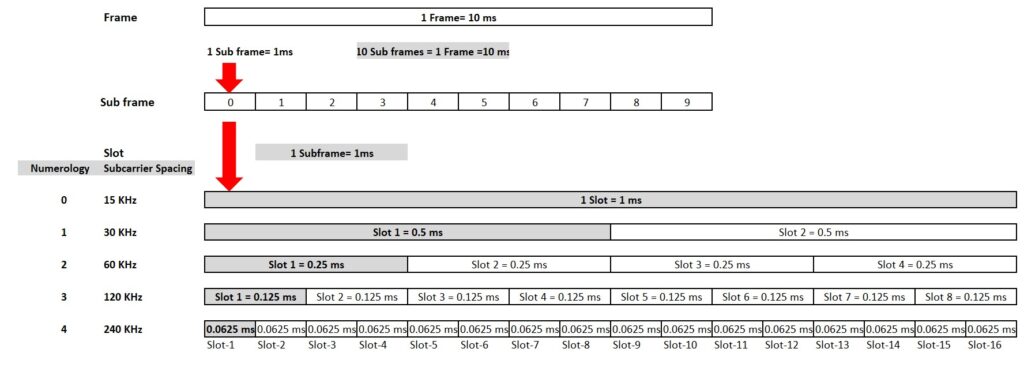
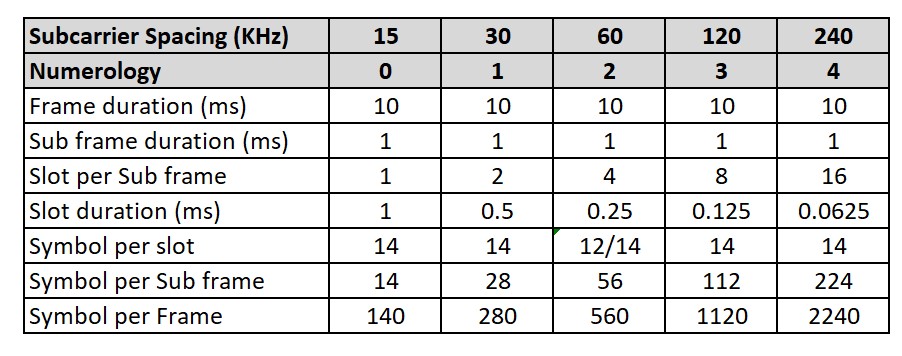
    The highest-level structure in the 5G NR frame hierarchy is the radio frame. The radio frame has a duration of 10 milliseconds (ms) and is further divided into 10 subframes. The number of slots in a radio frame depends on the subcarrier spacing and the slot duration.

    • Subframe:

    A radio frame is divided into subframes, each with a duration of 1 millisecond (ms).

    • Slot:

    Each subframe is further divided into slots. The number of slots in a subframe depends on the subcarrier spacing. A slot can carry multiple symbols.

    • Symbol:

    A symbol is the basic unit of time within a slot. The number of symbols in a slot depends  subcarrier spacing. A symbol carries information in the time and frequency domains.

    • Resource Blocks:

    A resource block (RB) is a group of contiguous subcarriers in the frequency domain and symbols in the time domain. The number of subcarriers and symbols in a resource block depends on the subcarrier spacing and the slot duration.

    The 5G NR frame structure is flexible and supports different numerologies, which refer to the subcarrier spacing and time duration configurations. The numerology defines the number of subcarriers per resource block, the number of symbols per slot, and the duration of a slot.

    Pranab Hazarika

    Author || BE || MBA || PMP || IoT Certified ||

    https://amzn.to/3XiaIUI

  • RF Planning-A Practical Hand-Book

    A Practical Hand-Book on Telecom Radio Network Planning-Mobile Communication

    by Pranab Hazarika

    Available in Amazon now: Your copy is here..

    This image has an empty alt attribute; its file name is IMG-20221111-WA0001-1-1.jpg

    https://amzn.to/3U7mNcr

    “”Life is interesting for interesting people””

    –Earl Nightingale

    In my 15 years plus career in telecom field I learned many new things.

    Out of which, 80% things I didn’t read or learn neither in my Engineering nor even through any other formal education system.

    As Ralph Waldo Emerson said in his essay “What we do not call education is more precious than that which we call so.”

    I realized one more thing. Though many new lessons I learned, many of them used to forget very easily.

    I worked in 4 different companies. All have different works and processes.

    I learned those new works and new process and was efficient during those times.

    But now, when I try to remember what I did and how I did, it is hard for me to remember all those in details.

    So one day I decided to note down my works what I do, in day to day basis. The whole process, learning and take aways.

    After few days I decided to publish those learning as blog post. And finally this book is for You. This book contains step-by-step process to complete many tasks related to Radio Network Planning. Topics choose to explain here are the basic building blocks with slight variations for different technologies (2G, 3G, 4G or 5G and so on)

    Share what you know:

    “Show your Work” by Austin Kleon, an amazing book has impressed me a lot. He emphasized on sharing and showing what you do.

    So here I have selected few interesting and important topics of network radio planning, and systematically put them step by step way to form this book.

    The purpose of this book is to provide you with an easy to ready collections. This material certainly isn’t the last word on the subject. This diminutive volume could not possibly cover all the concepts of RF planning.

    You would love to read this book. Because this is totally a practical guide book. This includes work of telecom engineers. I added few theoretical concepts which are mandatory to add to see those concepts practically.

    This book is for everyone. If you are an experienced person in telecom segment, you will feel like you are writing your experience here. For amateur it will be an easy step-by-step guide book.

    For non-Telecom person it will be great experience to know the backstage activities of your mobile network, which is becoming a part and parcel of your daily life now.

    This book is not only about WHAT, but also about HOW.

    How Open minded are you to enjoy and experience this interesting reading.

    Earl Nightingale wrote

    “Life is interesting for interesting people”

    THANK YOU.

    Pranab Hazarika

    PranabHazarika.com

    Available in Amazon now:

    This image has an empty alt attribute; its file name is IMG-20221111-WA0001-1-1.jpg

    https://amzn.to/3U7mNcr


  • How to get E1-KLM details in Ericsson BSC in Winfiol

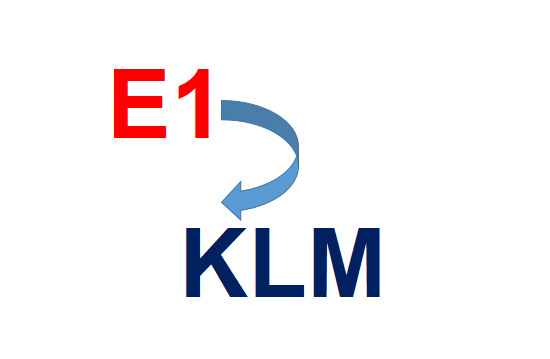
    How to get E1-KLM details in Ericsson BSC in Winfiol

    4 Commands to get E1 details in winfiol

    Any command for 2G, related to any BSC can be executed only after log in to BSC first.

    After log in to BSC we can execute any command in that particular BSC.

    To Log in any BSC :

    Command: eaw BSC name;

    Example: eaw RBSCHK2;

    Now let’s see 4 commands which we can use to get details of E1, KLM in a BSC.

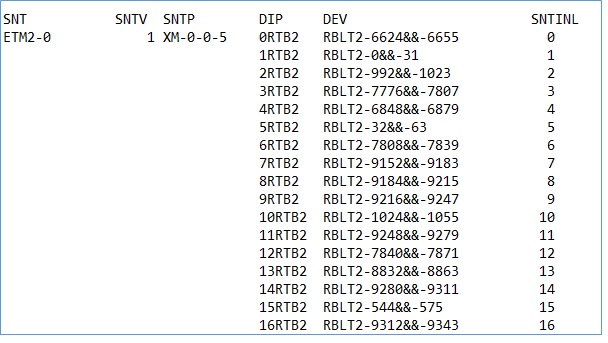
    ntcop:snt=all;—————–E1 details/Device detail

    The below screen shot is the output of the command ntcop:snt=all; .Through this command we can get STM wise details for each E1. In a single STM there are 63 E1s. Details of each E1 is available through this command. In the below mentioned screen shot ETM2-0 is the STM name. Then against each E1 DIP, Device (DEV) and SNTILN are mentioned. Against each SNTINL we get KLM details, e.g. KLM against SNTINL 1 is 211 and so on.

    Likewise details for all available STMs in that same BSC can be extracted by using this ntcop:snt=all; command.

    Here in each example, though I am showing only up to 16 E1 but through the command we will get details of all E1s. (for 1 STM 63 E1, and for all STMs available in the BSC)

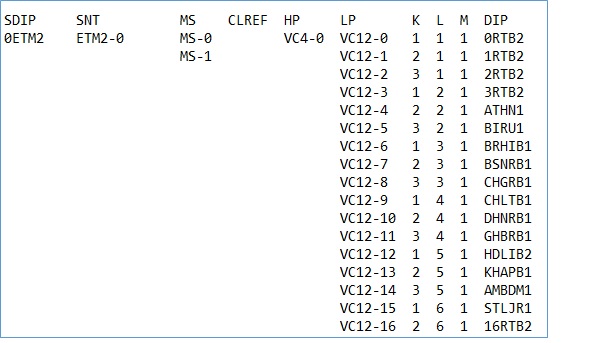
    tpcop:sdip=all;——————-SNTINL details

    By using tpcop:sdip=all; we can receive below mentioned details. Here also we get STM wise each E1 details for all STMs.

    Don’t be confused with the screen shot of above command. Both data are for two different BSCs.

    Here KLM actual value is indicated instead of SNTINL number. E.g. VC12-1 has KLM value 211, which represents SNTINL value 1. We don’t get device details through this command.

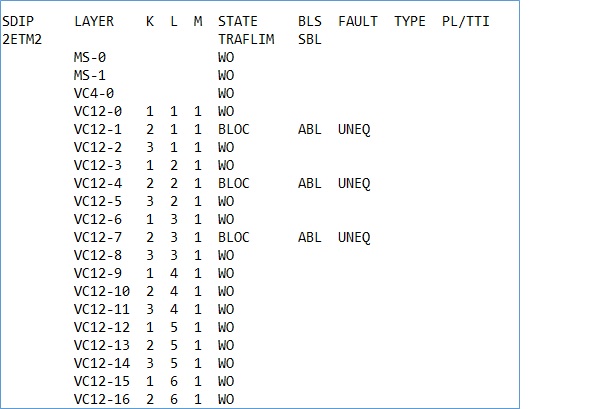
    tpstp:sdip=all;—————-E1 status

    tpstp:sdip=all; gives E1 status. Which E1 is currently busy/used and which are free. It gives details of each E1 KLM number wise for all STMs. If ABL is mentioned against some E1 then we can check those KLMs for free E1. They may not be free and can show ABL if site is down and currently not working.

    So before using ABL mentioned E1, we have to check those KLMs properly.

    If instead of ABL (Automatic blocked label), if MBL (Manually blocked label) is indicated against any E1/KLM then those E1 are manually blocked and currently free to use.

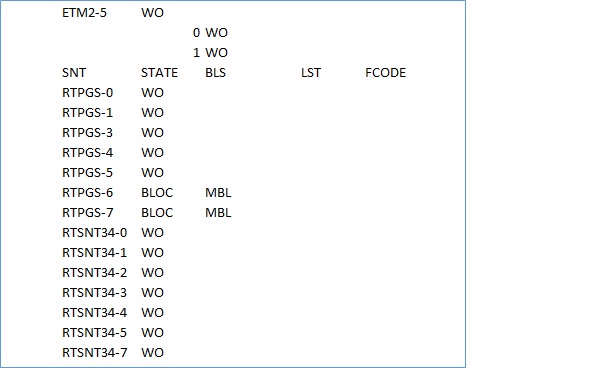
    ntstp:snt=all;——————HW status

    SNT wise, E1/KLM is currently used, or free can be seen by using ntstp:snt=all;

    If we use above all three commands to get details of all E1s then we can avoid this command. This command will not give you details for all 63E1s of each STMs.

    Conclusion:

    These commands are useful to check which E1 are free. Free E1 we can use for site migration from one BSC to another BSC. During site migration we require to know free E1 along with DIP, KLM, attached device details and all. For those purpose these 4, especially top 3 commands are very useful.

    Pranabjyoti Hazarika

    BE | MBA | PMP | IoT-Certified

    www.PranabHazarika.com

    <script async src="https://pagead2.googlesyndication.com/pagead/js/adsbygoogle.js?client=ca-pub-2754967439384345"
         crossorigin="anonymous"></script>
  • The PranabHazarika.com Privacy Policy

    PranabHazarika (aka PranabHazarika.com) (“Company,” “we,” or “us”) respects your privacy and is committed to protecting it through this Privacy Policy.

    This Privacy Policy governs your access to and use of PranabHazarika.com including any content, functionality and services offered on or through PranabHazarika.com (the “Website”), whether as a guest or a registered user.

    When accessing the Website, we will learn certain information about you, both automatically and through voluntary actions you may take, during your visit. This policy applies to information we collect on the Website and in email, text, or other electronic messages between you and the Website.
    Please read the Privacy Policy carefully before you start to use the Website.

    Age of Consent

    By using this site, you represent that you are at least the age of majority in your state or province of residence, or that you are the age of majority in your state or province of residence and you have given us your consent to allow any of your minor dependents to use this site.

    PranabHazarika.com does not knowingly solicit or collect personally identifiable information online from children under the age of 13. If you become aware of any personally identifiable information we have collected from children under 13, please contact us and it will be removed.

    Minors under 18 years of age may have the Personal Information that they provided through the site deleted by contacting us requesting deletion.

    Information We Collect About You

    When you access the Website, the Company will learn certain information about you during your visit. The Website provides various places for users to provide information. We collect information that users provide by filling out forms on the Website, communicating with us via contact forms, providing comments or other feedback, and providing information when ordering a product via the Website.
    We use information you provide to us to provide the service and/or deliver the requested product, to improve our overall performance, and to provide you with offers, promotions, and information.

    Information We Collect Through Automatic Data Collection Technology.

    As you navigate through our Website, we may use automatic data collection technologies including Google Analytics to collect certain information about your equipment, browsing actions, and patterns. This will generally include information about your location, your traffic pattern through our website, and any communications between your computer and our Website. Among other things, we will collect data about the type of computer you use, your Internet connection, your IP address, your operating system, and your browser type.
    The information we collect automatically is used for statistical data and will not include personal information. We use this data to improve our Website and our service offerings. To the extent that you voluntarily provide personal information to us, our systems will associate the automatically collected information with your personal information.

    Use of Cookies And Pixels

    Similar to other commercial websites, our website utilizes a standard technology called “cookies” and server logs to collect information about how our site is used. Information gathered through cookies and server logs may include the date and time of visits, the pages viewed, time spent at our site, and the websites visited just before and just after our own, as well as your IP address.

    A cookie is a very small text document, which often includes an anonymous unique identifier. When you visit a website, that site’s computer asks your computer for permission to store this file in a part of your hard drive specifically designated for cookies. Each website can send its own cookie to your browser if your browser’s preferences allow it, but (to protect your privacy) your browser only permits a website to access the cookies it has already sent to you, not the cookies sent to you by other sites.
    The Company reserves the right to use technological equivalents of cookies, including social media pixels. These pixels allow social media sites to track visitors to outside websites so as to tailor advertising messages users see while visiting that social media website. The Company reserves the right to use these pixels in compliance with the policies of the various social media sites.

    PranabHazarika may use cookies and tracking technology which are useful for gathering information such as browser type and operating system, tracking the number of visitors to the site, and understanding how visitors use the Site. Personal information cannot be collected via cookies and other tracking technology, however, if you previously provided personally identifiable information, cookies may be tied to such information. Third parties such as our advertisers may also use cookies to collect information in the course of serving ads to you. Most web browsers automatically accept cookies, but you can usually modify your browser setting to decline cookies if you prefer. Google, in particular, as a third party vendor, uses cookies to serve ads on this site. Google’s use of the DART cookie enables it to serve ads to your users based on their visit to your sites and other sites on the Internet. Users may opt out of the use of the DART cookie by visiting the Google ad and content network privacy policy.

    Third Party Use Of Cookies

    Some content or applications, including advertisements, on the Website are served by third-parties, including advertisers, ad networks and servers, content providers, and application providers. These third parties may use cookies alone or in conjunction with web beacons or other tracking technologies to collect information about you when you use our website. The information they collect may be associated with your personal information or they may collect information, including personal information, about your online activities over time and across different websites and other online services. They may use this information to provide you with interest-based (behavioral) advertising or other targeted content.
    We do not control these third parties’ tracking technologies or how they may be used. If you have any questions about an advertisement or other targeted content, you should contact the responsible provider directly.
    International Transfer

    Your information, including Personal Information, may be transferred to — and maintained on — computers located outside of your state, province, country or other governmental jurisdiction where the data protection laws may differ than those from your jurisdiction. If you are located outside United States and choose to provide information to us, please note that we transfer the information, including Personal Information, to the United States and process it there. Your consent to this Privacy Policy followed by your submission of such information represents your agreement to that transfer.

    Links To Other Sites

    Our Service may contain links to other sites that are not operated by us. If you click on a third party link, you will be directed to that third party’s site. We strongly advise you to review the Privacy Policy of every site you visit.
    We have no control over, and assume no responsibility for the content, privacy policies or practices of any third party sites or services.

    Comments

    Comments submitted to this website are the responsibility of the commenter. We reserve the right to remove or edit comments at our discretion. Site URLs (if provided) are published along with comments. E-mail addresses are required with the submission of comments but are not disclosed, unless the commenter deliberately does so him/herself by entering the e-mail address in the main comment box in addition to the box clearly labeled for the e-mail address.
    PranabHazarika reserves the right to delete any comments that it deems not beneficial to the readership. This includes but is not limited to comments containing profanity, self promotion, harassment, threats, or spam of any sort.

    Email Information

    If you choose to correspond with us through email, we may retain the content of your email messages together with your email address and our responses. We provide the same protections for these electronic communications that we employ in the maintenance of information received online, mail, and telephone. This also applies when you register for our website, sign up through any of our forms using your email address or make a purchase on this site. For further information see the email policies below.
    Email Policies

    We are committed to keeping your e-mail address confidential. We do not sell, rent, or lease our subscription lists to third parties, and will not disclose your email address to any third parties except as allowed in the section titled Disclosure of Your Information.
    We will maintain the information you send via e-mail in accordance with applicable federal law.

    In compliance with the CAN-SPAM Act, all e-mails sent from our organization will clearly state who the e-mail is from and provide clear information on how to contact the sender. In addition, all e-mail messages will also contain concise information on how to remove yourself from our mailing list so that you receive no further e-mail communication from us.
    Our emails provide users the opportunity to opt-out of receiving communications from us and our partners by reading the unsubscribe instructions located at the bottom of any e-mail they receive from us at anytime.
    Users who no longer wish to receive our newsletter or promotional materials may opt-out of receiving these communications by clicking on the unsubscribe link in the e-mail.

    How And Why We Collect Information

    The Company collects your information in order to record and support your participation in the activities you select. We use this information to track your preferences and to keep you informed about the products and services you have selected to receive and any related products and/or services. As a visitor to this Website, you can engage in most activities without providing any personal information. It is only when you seek to download resources and/or purchase products that you are required to provide information.
    If you opt to receive any free resources, participate in any free training programs, register for a webinar, register for a live event, register for a seminar, or purchase any products sold by the Company on this Website, we will automatically enroll you to receive our email newsletter. If you do not wish to receive this communication, you can unsubscribe anytime. We include an “unsubscribe” link at the bottom of every email we send. If you ever have trouble unsubscribing, you can contact us here requesting to unsubscribe from future emails.

    How Do We Use the Information That You Provide to Us?

    We use personal information for purposes of presenting our Website and its contents to you, providing you with information, providing you with offers for products and services, providing you with information about your subscriptions and products, carrying out any contract between you and the Company, administering our business activities, providing customer service, and making available other items and services to our customers and prospective customers.

    From time-to-time, we may use the information you provide to us to make you offers to purchase products and services provided by third parties in exchange for a commission to be paid to us by such third parties. Should you opt to take part in such promotions, the third parties will receive your information.
    From time-to-time, we may use the information you provide to us to display advertisements to you that are tailored to your personal characteristics, interests, and activities.

    Disclosure Of Your Information

    As a general rule, we do not sell, rent, lease or otherwise transfer any information collected whether automatically or through your voluntary action.
    We may disclose your personal information to our subsidiaries, affiliates, and service providers for the purpose of providing our services to you.
    We may disclose your personal information to a third party, including a lawyer or collection agency, when necessary to enforce our terms of service or any other agreement between you and the Company.

    We may disclose information when legally compelled to do so, in other words, when we, in good faith, believe that the law requires it or for the protection of our legal rights or when compelled by a court or other governmental entity to do so.

    How Do We Protect Your Information and Secure Information Transmissions?

    The security of your Personal Information is important to us, and we strive to implement and maintain reasonable, commercially acceptable security procedures and practices appropriate to the nature of the information we store, in order to protect it from unauthorized access, destruction, use, modification, or disclosure. However, please be aware that no method of transmission over the internet, or method of electronic storage is 100% secure and we are unable to guarantee the absolute security of the Personal Information we have collected from you.

    We employ commercially reasonable methods to ensure the security of the information you provide to us and the information we collect automatically.
    Email is not recognized as a secure medium of communication. For this reason, we request that you do not send private information to us by email. However, doing so is allowed, but at your own risk. Credit Card information and other sensitive information is never transmitted via email.

    The Company may use software programs to create summary statistics, which are used for such purposes as assessing the number of visitors to our site, what information is of most and least interest, determining technical design specifications, and identifying system performance or problem areas.
    For site security purposes and to ensure that this service remains available to all users, the Company uses software programs to monitor network traffic to identify unauthorized attempts to upload or change information, or otherwise cause damage.

    Policy Changes

    It is our policy to post any changes we make to our privacy policy on this page. If we make material changes to how we treat our users’ personal information, we will notify you by email to the email address specified in your account and/or through a notice on the Website home page. The date the privacy policy was last revised is identified at the bottom of the page. You are responsible for ensuring we have an up-to-date active and deliverable email address for you, and for periodically visiting our Website and this privacy policy to check for any changes.

    Visitors’ GDPR Rights

    If you are within the European Union, you are entitled to certain information and have certain rights under the General Data Protection Regulation. Those rights include:
    We will retain the any information you choose to provide to us until the earlier of: (a) you asking us to delete the information, (b) our decision to cease using our existing data providers, or (c) the Company decides that the value in retaining the data is outweighed by the costs of retaining it.

    • You have the right to request access to your data that the Company stores and the rights to either rectify or erase your personal data.
    • You have the right to seek restrictions on the processing of your data.
    • You have the right to object to the processing of your data and the right to the portability of your data.
    • To exercise these rights please contact us here.
    • To the extent that you provided consent to the Company’s processing of your personal data, you have the right to withdraw that consent at any time, without affecting the lawfulness of processing based upon consent that occurred prior to your withdrawal of consent.
    • You have the right to lodge a complaint with a supervisory authority that has jurisdiction over issues related to the General Data Protection Regulation.

    We require only the information that is reasonably required to enter into a contract with you. We will not require you to provide consent for any unnecessary processing as a condition of entering into a contract with us.

    Contact Us

    The Company welcomes your questions or comments regarding the Privacy Policy:

    Mail: hazarikap@gmail.com

    Last updated Dec’28, 2021

  • Copyright

    Copyright © 2018 by PranabHazarika.

    All Rights Reserved. No part of the content of this website may be reproduced, stored in a retrieval system (including but not limited to computers, disks, external drives, tapes, electronic or digital devices, e-readers, websites), or transmitted in any form or by any means ( including but not limited to cyclostyling, photocopying, docutech or other reprographic reproductions, mechanical, recording, electronic, digital versions) without the prior written permission of the publisher/creator PranabHazarika, nor be otherwise circulated in any form of binding or cover other than that in which it is reproduced and without a similar condition being imposed on the subsequent reader/purchaser.